ગુજરાતી

a time bomb
Some villages around the Ring Road in eastern Ahmedabad have become centers of mini Shivakashi i.e. firecracker factories.
Illegal firecracker factories caught fire in fields and vacant plots. There are 200 factories within 10 km in the surrounding villages of Vastral, Vatva. Around 500 factories near Diwali
Ramol incident
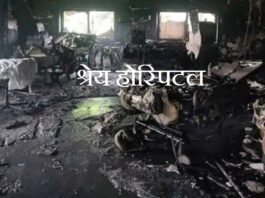
On Saturday, July 18, 2026, a massive fire broke out in an illegal firecracker factory on Ramol-Vastral Road in Ahmedabad. A total of 10 people, including 3 children, 4 women and 2 men, died. 10 living people became skeletons. Six people were undergoing treatment in the hospital, one of whom later died. Within a span of 10 seconds the entire shed was blown away by the explosion. In which there was a mother and her 4 innocent children from the same family. Factory owner Mehul Dodia was absconding. Collector, Police, Fire Brigade, Ahmedabad Municipal Corporation are responsible for that.
CCTV footage shows that at 3:54 pm, a spark erupted in a corner of the shed and two people ran outside. Within 5 seconds (3:55:04 pm) the entire factory was blown to pieces by the devastating explosion.
After an explosion at a firecracker factory in Ramol, a thick plume of smoke could be seen from several kilometers away.
dead
Rinku Bharatbhai Charel (Age: 16 years)
Raveena Bharatbhai Charel (Age: 14 years)
Shiva’s Bharatbhai Charel (Age: 14 years)
Ramilaben Bharatbhai Charel (Age: 37 years)
Viral alias Nirav Bharatbhai Charel (Age: 06 years)
Savitaben Sureshbhai Damor (Age: 38 years)
Ushaben Govindbhai Dhimbhai Damor (Age: 45 years)
Mohammad Ashrar Irfan Ali Syed (Age: 20 years)
Azharuddin Ruknuddin Qazi (Age: 25 years)
a joke
Prime Minister Narendra Modi Rs. 2 lakh and Chief Minister Bhupendra Patel Rs. Made fun of by announcing assistance of Rs 4 lakh to the deceased. The application form was given after protesting in the office of Ahmedabad Municipal Corporation.
One lakh rupees should be given immediately to the family of the deceased. A demand for financial assistance of Rs 1 crore was made. Give best treatment to the injured free of cost. Strict action should be taken by registering a case against negligent officials and factory owners. A strict investigation should be immediately conducted against illegal firecracker factories, explosive material warehouses and other dangerous entities operating across Gujarat.
Where is the factory?
The factory operated in open plots and sheds used for firecracker manufacturing and processing in Mahmoodpura, on the banks of the canal, on Ramol-Gatrad Road, near Talent School in Mahmoodpura area.
The fire department received a call at 3:30 in the afternoon. By the time the fire brigade arrived, the injured and trapped people had been taken out.
presented in court
The owner of the factory is Mehul Dodiya, who has been detained. Permission was sought from the police for the factory. But the police did not allow him to start it illegally. Both the accused were booked before Additional Judicial Magistrate, Ghee Kanta, D.R. Arrested by. Thakur was produced in the court and 14 days’ remand was demanded. Considering the seriousness of the case and the arguments of the government lawyer, the court gave police remand to both the accused Mehul Dodiya and Sadiq Syed till July 27 (7 days).
There was a fire 20 days ago
There was a fire incident in this factory 20 days ago also. In which two laborers died. No action was taken by the system. If action had been taken, 10 people would not have died.
factory since 20 years
Ramila Dodiya L.G. He was undergoing treatment in the hospital. Mehul Dodiya’s mother Ramila Dodiya was running the firecracker factory for the last 20 years. Initially Narendra and Ramila started the business of making firecrackers by renting a space.
Earlier in 2014 also, there was a massive explosion in the factory in which a 14 year old child died. His license was cancelled.
Ramila got a new license in the name of son Mehul Dodiya in 2020.
The police gave a negative report on the license renewal application of this factory. But the factory was still running.
The original owner of the land and the financier will be investigated in the scam.
FSL
According to the FSL report, as per the rules, the factory was allowed to store a maximum of 15 kg of potassium nitrate, but even more quantity of dangerous explosive was kept here.
According to SIT chief and Additional Police Commissioner Jaipalsingh Rathore, the explosion is suspected to be caused by a mixture of chemicals or potassium, soda and sulfur due to friction of slippers. Ahmedabad Municipal Commissioner is Banchanidhi Pani. Within 5 minutes RAF officer Ratul Kumar and his team reached.
huge explosion
The explosion was so powerful that a large iron sheet from the factory flew into the air and fell straight on the opposite bank of the canal. Papers for packing tiffin, drying clothes and crackers were scattered.
kitchen 25 feet away
There was accommodation for the artisans in a small room at a distance of 20 to 25 feet. There was a gas cylinder, stove, utensils and cot in this room.
13 factories closed
There are 50 illegal firecracker factories within a radius of 9 km from Ramol to Dhamtawan. A campaign was launched against 13 other factories located in Ramol area.
Of which 12 were already closed. A campaign was launched against about 40 to 40 to 45 illegal constructions. Action was taken on two units. A huge quantity of firecrackers were seized. It was destroyed with water hammer. Both the units were sealed.
the lock was broken
Boards for sale and manufacturing of firecrackers were seen here. There are 7 factories in the fields on both sides of the 1 kilometer road. Case
The factories and their stalls had been closed for a month and a half. Following the accident, most operators locked up the factories and fled. There is a complete lack of safety; the process of making firecrackers—which can explode in just 10 seconds—takes 10 hours. Regulations require keeping 15 to 16 fire extinguishers along with 20 to 25 buckets of sand and water. Forty percent of factories in Ahmedabad lack fire safety facilities. Children, youth, and women used to manufacture firecrackers amidst gunpowder. No insurance coverage was provided for the workers. Women and children make up 20 to 30 percent of the workforce. There is no water or sand available to extinguish fires. Fire alarms, extinguishers, water tanks, and sprinkler systems are missing. Even basic safety measures, such as hand gloves or adequate firefighting equipment, were absent. People burn to death because of officials and elected representatives; families are shattered. This is the BJP’s new model of a “safe state”! Firecracker explosions in Gujarat over five years:
20 April 2023: Four people died in an explosion in Aravalli.
10 May 2023: Fire in a warehouse.
21 April 2024: Explosion in Vatral, Ahmedabad; two deaths.
1 April 2025: 21 deaths, including 7 children, in Deesa.
1 April 2026: Explosion in Timbhi, Botad; 1 death, 2 injured.
10 June 2026: Two workers critically injured.
Corrupt officials granted improper approvals
Corruption
Applications to start factories are approved without inspecting the site. Sales licenses are issued without verifying fire safety measures. The discretionary powers held by officials like the Talati, Mamlatdar, and others lead to the creation of “live bombs” [unsafe factories]. An illicit roadside firecracker trade is flourishing in the villages of Vach, Bibipur, and Dhamtavan, operating under the guise of licenses obtained for ₹3 lakh. Through collusion between middlemen and corrupt officials, approvals are granted without any site inspections or fire safety checks. Licenses initially issued solely for sales are later converted into permits for illegal manufacturing units.
In the Ramol police station area, only 11 out of 13 factories were found to be operating in compliance with legal licenses and regulations.
No action was taken despite the matter being reported to the BJP MP.
Each factory employs between 10 and 25 workers.
Wages: ₹500!
Workers from nearby villages come to these factories to perform tasks such as filling gunpowder and packaging. They earn wages of ₹500.
Farm Land Rent
Farmers are paid a monthly rent of ₹2 lakh for half to one *bigha* of land. Makeshift sheds are erected to set up hazardous firecracker factories; a minimum of two *bighas* of land is required. Landowners lease out their land for 15 days in exchange for ₹1 lakh. Although the Collector has not renewed permissions for the past two to three months, these factories continue to operate privately under the watch of the police and other officials. Villagers had submitted a written representation regarding this issue to the local MP.
Investigation Team Formed
An SIT was constituted, but the Fire Department/AMC was excluded from the team. While this illegal factory had been operating unchecked in the Ramol area for 25 days, the responsibility for investigating the entire matter has been assigned to the very same police station’s PI, ACP, and DCP. No officials from departments other than the police have been officially involved.
The Charade of an Investigation
A familiar scene has once again unfolded in Ahmedabad, where the system wakes from its slumber only after a major tragedy strikes and innocent lives are lost. The Fire Department of the Ahmedabad Municipal Corporation (AMC) inspected 147 premises on July 19, 2026. Notices were issued to 30 units for violating regulations, and 4 units were sealed.
Under Section 6B of the Explosives Act, 1884, a permanent license issued by the Additional District Magistrate of Ahmedabad is mandatory for manufacturing or selling firecrackers. The 60-day approval process is rigorous; it requires clearances from the local police, Circle Officer, Mamlatdar, Deputy SP, Sub-Divisional Magistrate, and Superintendent of Police, in addition to a mandatory physical inspection of the site.
Applicants must submit details regarding age, residential address, proof of ownership or lease, a site map, a clerk’s license, and a valid Fire NOC. Despite these stringent legal requirements, illegal manufacturing hubs continue to flourish in Ahmedabad.
Zone | Number of Units Inspected
West Zone: 24 (Notices: 0)
Central Zone: 44 (Notices: 4)
North Zone: 15 (Notices: 1)
South West Zone: 21 (Notices: 21)
South Zone: 34 (Notices: 1)
North West Zone: 4 (Notices: 3)
East Zone: 5 (Notices: 0)
Total: 147 factories inspected; 30 issued notices. Notified Factories
ABC Transport, I.S. Logistics, Yard Shopping Mall, Ola Electric Service Center, Goodluck Furniture, Reza Furniture Mall, Honest Decor Pvt. Ltd., Akshat Shah Furniture, Puthawala Packaging, Salasar Laminate Ltd., S.K. Designer, Reny Cosmetic Company, West Point Honda,
Malu Surface Coating, Auto Mart, Air Power Service, Rajen Auto, M.M. Enterprise, S.K. Tiles, Jagruk Auto Parts, Tazbani, Avinash Traders (Seasonal), Gujarat Papad Bhandar, Jai Hind Stores, Radhe Seasonal Stores, Maa Ambika Seasonal Store, Heena Traders, China Fireworks, Gurukripa Fireworks, and Manav Mandir Fireworks—these shops and factories were located there.
Sealed
Units Sealed
Kantibhai Chinilal Shrimali, Vastral, Village Daskroi
Mohsin Khan Siddiq Khan Pathan, near Bakshi’s Well, Nabimiya’s Farm, Ramol
Jishanuddin Zahiruddin Sayed, Narol, Ahmedabad
Kamruddin Badruddin Sayed (“King Fire Works”)
Ruthless BJP
Be it the horrific Takshashila [incident] in Surat
Whether it is a fire incident, the heart-wrenching game zone tragedy in Rajkot, or the fire at a firecracker warehouse in Deesa—in all these events…
…innocent people have burned to death. The government evades its responsibility by offering aid and feigning sympathy. In reality, callous rulers and a corrupt system are primarily responsible for these tragic accidents.
Innocent lives are being lost to fires, yet the government has failed to take any concrete action.
Whenever a tragedy occurs, the government resorts to the measure of appointing a high-level inquiry committee.
Vanch Village
The first firecracker factory in Vanch village—located in the Daskroi taluka of Ahmedabad city—was established in 2005. More than 5,000 people work across 50 firecracker factories.
Firecrackers from Vanch village are supplied throughout the state and to neighboring states as well. Production begins six months prior to Diwali. Setting up a firecracker factory requires an investment of ₹20 to ₹25 lakh, and GST is applicable. Many workers have been engaged in manufacturing firecrackers for as long as 40 years.
The Process
Firecrackers are made by grinding gunpowder into a fine powder. A long fuse is created by inserting a thread into this powder and letting it dry; it is then cut into sections. Subsequently, one gram of gunpowder is filled into casings like ‘Kothi’ or ‘Mirchi Bomb’ containers. After filling the powder, a base is prepared using a mixture of soil and glue. Once dried for four hours, paper is pasted over it, followed by another two hours of drying. Finally, the products are packed and dispatched to traders. The manufacturing process for a firecracker that explodes in just 10 seconds takes 10 hours to complete.
Acid Factories
A large number of factories dealing with acids and flammable chemicals are operating without permits in areas such as Vinzol, Narol, Rakhiyal, and Vatva. There are between 8,000 and 10,000 factories operating in Ahmedabad. …which lack adequate fire safety facilities.
New Announcement
The government has stated that the Industries Department will be the sole authority for issuing Fire NOCs across Gujarat. This rule applies to all factories, regardless of whether they are located within or outside municipal corporation or municipality limits.
It will inspect industrial units and issue valid Fire NOCs. The Labour Department will oversee workplace safety, accident prevention, and compliance with the Factories Act.
A separate special department will be established for industrial fire safety. Distinct fire service departments will be created for industrial and non-industrial areas.
No decision regarding the responsibility for fire safety in industrial units in Gujarat had been taken since 2021.
Firecracker Trade
Firecrackers worth approximately ₹500 crore are burst in the state annually. The annual turnover of the firecracker industry based in Gujarat is around ₹150 crore. Of this, 30 percent is manufactured within Gujarat, consisting mostly of simple firecrackers—such as *lavangiya* (garland) crackers, fountains (*kothi*), ground spinners (*chakli*), cap gun pellets (*tikdi*), and sparklers (*taramandal*).
Seventy percent of the firecrackers are imported from Sivakasi, Tamil Nadu. Ahmedabad is home to 300 firecracker factories—comprising both legal and illegal operations—employing 10,000 people. Deesa is the second-largest center for firecracker production; it has long hosted large-scale factories and warehouses, one of which saw a fire that claimed 21 lives. Nationally, the annual firecracker trade is valued at approximately ₹6,000 to ₹7,000 crore. There are about 1,500 licensed, official factories, with 1,482 of them located in Tamil Nadu. The network of illegal markets and factories is vast. India is the world’s second-largest firecracker manufacturer, after China. The city of Sivakasi in Tamil Nadu serves as the primary hub for 90% of India’s firecracker industry. It provides direct employment to 3 lakh people and indirect employment to over 5 lakh people. Chinese firecrackers are smuggled into the country. In states like Bihar, Uttar Pradesh, West Bengal, and Gujarat, firecrackers are manufactured without licenses in small, illegal home-based units or temporary sheds. These operations lack official tax records and mostly produce counterfeit goods.
Firecrackers are produced through home-based cottage industries and in temporary sheds set up for festivals.
Following Supreme Court orders, large, licensed factories are now rapidly manufacturing ‘green crackers’ that cause less pollution.
Illegal units continue to use banned chemicals.
Factories in the Country
State | Licensed (PESO) Factories | Estimated Illegal/Cottage Units | Annual Production Value (Estimated) | Key Hubs & Comments
Tamil Nadu | 1,085 licensed factories | 1,500 illegal units | |
Gujarat | 15 licensed factories | 200–300 illegal units | |
Bengal | 50 licensed factories | 1,000 illegal units | |
Madhya Pradesh | 30–150 licensed factories | | |
Uttar Pradesh | 40 licensed factories | 300 illegal units | |
Haryana (Rohtak), Maharashtra, and Bihar | | | | Business worth crores.
Gujarat has a total of 51,000 registered factories across various sectors.
Policy Gaps
The Labour Department lacks fire extinguishers.
There is a lack of specially trained fire personnel.
No Fire No-Objection Certificates (NOCs) were being issued. Factories are experiencing serious fire incidents, resulting in loss of life, property, and financial damage.
The Chhatral Industrial Area witnesses multiple fire incidents annually, yet it currently relies on the Kadi and Kalol fire stations.
Urban Development Department (UDD)
Will issue fire safety certificates.
Will set standards. Will implement fire regulations.
Will develop the fire brigade.
Will establish new wings.
Labour Department
Accident prevention
Focus on compliance with factory safety laws
Keep in mind.
Managing operational risk.
Hazardous Chemicals
The Supreme Court and the Ministry of Environment, Government of India, have imposed a complete ban on six major chemicals used in firecrackers, as they are highly dangerous and toxic.
They cause severe air pollution and pose a life-threatening risk to human health.
Banned Chemicals
Barium
Barium salts (such as barium nitrate) are used to produce an attractive green color and extend the shelf-life of firecrackers. Exposure leads to serious health issues like breathing difficulties, lung diseases, and irregular heartbeats.
Lithium is used to produce a brilliant red color when firecrackers burst in the sky. It damages the nervous system and poses a significant risk to pregnant women.
Lead is used in firecrackers to create specific crackling sounds upon detonation. When inhaled, it has a direct toxic effect on the brains, kidneys, and digestive systems of adolescents.
Arsenic is used to stabilize the chemical mixture in firecrackers and produce bright blue or white light. It is a highly toxic substance that can cause cancer and skin diseases.
Mercury is used to enhance the explosive power and intensify the colors of firecrackers. It can cause permanent damage to kidney and brain function.
Antimony is used in fireworks to create beautiful sparkles, glitter effects, or showers of sparks. Its fumes cause eye irritation and respiratory tract infections.
Potassium chlorate is a banned chemical often found in Chinese-made firecrackers. It is highly flammable and can cause massive explosions.
Scientists have developed ‘Green Crackers,’ which do not use barium nitrate at all. These produce 30% less pollution compared to traditional firecrackers. If you are looking for ‘green crackers,’ specific QR codes and logos are used to identify them.
This chemical is manufactured in Gujarat.
Authorized manufacturers in India include several large, licensed companies that produce oxidizers and metal powders.
Barium Nitrate (the chemical that produces green light): This chemical is primarily manufactured for the pharmaceutical, glass, and ceramic industries.
In India, it is produced by companies such as Vishnu Priya Chemicals (Hyderabad),
Ravi Chem Industries (Ankleshwar, Gujarat),
and Chemical Bull (Mumbai).
Potassium Chlorate (a highly explosive chemical): Pandian Chemicals Limited (PCL) and Vaigai Chemicals (Vaigai), both based in Tamil Nadu, are the country’s largest manufacturers of this chemical.
Magnesium and Aluminium Powder: These powders are supplied by major mining and metal refinery companies that produce metal powders; these are used in firecrackers to generate bright white light and loud sounds.
These chemicals are sold in the open market as ‘industrial raw materials.’ Illegal firecracker manufacturers purchase them—without invoices—from local suppliers and middlemen, often citing other industries (such as paints or textiles) as the intended use.
There are thousands of firecracker manufacturing factories in and around Sivakasi where the use of potassium chlorate is permitted. Often, these chemicals are smuggled from the quotas allocated to authorized factories into illegal firecracker units.
Smuggling from China: Large quantities of highly dangerous chemicals, such as potassium chlorate, are illegally smuggled into India via shipping containers under false labels like ‘Chinese firecrackers’ or ‘raw chemicals.’
The government and PESO (Petroleum and Explosives Safety Organization) maintain strict surveillance over explosives in India. PESO (Petroleum and Explosives Safety Organization) is now mandating a ‘barcode and tracking system’ for hazardous chemicals—covering everything from production to sale—to ensure that companies cannot sell legally manufactured chemicals to illegal firecracker factories. (Google translation from Gujarati; see original report)